

Is San Marino a heroic ode to liberty or just a glorified souvenir shop that declared independence?
My skepticism toward the world’s oldest republic — a small enclave bordered by Italy (but mostly the province of Rimini) on all sides — had put me off visiting, despite living a short train and bus ride away. The Italians I know harbor generally bad opinions of San Marino, dismissing it as a gimmick or a money laundering racket for dirty Italian money. Think Switzerland without the substance.
A few (foreign) friends had gone there to watch the San Marino national football team, which has its own peculiar charm. As a full member of FIFA, San Marino can theoretically compete in the World Cup just like any other country and so often plays qualifiers against “big teams” — a mismatch that frequently produces hilariously lopsided results.
But there’s something romantic about watching a team of postmen, IT salesmen and wine growers — your friends and neighbors, basically — line up against footballing giants such as Germany, France and Spain. Despite a heroic 3-1 victory over Liechtenstein last year (the first time they had ever scored more than one goal in a match), the San Marino team is currently at the bottom of the FIFA rankings, behind the national teams of Anguilla, the British Virgin Islands and Guam. Their win-draw-loss ratio currently stands at 3-11-204.
Recently I found myself in Rimini slightly numb to all the loud bars and bronzed beach rats and gazed curiously toward San Marino, just a 30-minute bus ride away. And I thought: why not go, even just for the afternoon?
The story of San Marino
The sammarinesi love to mention how they are the world’s oldest republic and sovereign state with what they claim is the longest life expectancy in the world (85.7 years). That their independence was secured through a mix of shrewd diplomacy and the strategic insignificance of their tiny territory. They’ll tell you that Napoleon once offered to expand their borders, and that they proudly declined. That they sheltered Giuseppe Garibaldi and his wife Anita as they fled the Austrians and how Garibaldi, out of gratitude, honored San Marino’s wish to remain separate from Italy. That they once sent a letter to Abraham Lincoln and that he sent one back expressing his admiration for their republic. That until the 1970s this was a poor, poor place and now it’s a rich, rich place despite no apparent resources, industry or capital. That their only prison had to close because there was no crime. That they wouldn’t want to live anywhere else.
The local pride is similar to the kind you find in small-town Italy. But San Marino’s distinctions from Italy are more layered than they might appear. While Italy was under Fascist rule, San Marino had its own Fascist government. The Duce here was called Giuliano Gozi and he had the same bald head and pompous look as Mussolini. Much of the old city was restored in the 1930s and ‘40s by a local architect called Gino Zani in a Fascist Deco style that mirrored the architectural trends of Mussolini’s Italy. During World War II, despite Gozi’s token implementation of racial laws modeled after Mussolini’s, San Marino offered refuge to around 150,000 Italian civilians, including many Jews. Then, in the postwar years, San Marino made history again: From 1945 to 1957, it was governed by the world’s first democratically elected communist government. In 1957, the country was plunged into a de facto civil war, with both communist and opposition parties setting up militias and rival provisional governments. Since then, the country has focused its efforts on becoming as rich as possible, largely through tourism and banking.
Their official language is Italian, but there is a local San Marino dialect, similar to the Rimini one, though no one under the age of 45 knows how to speak it. Though the sammarinesi are incredibly proud of their independence, culturally they share many similarities with the Romagna region which surrounds them. The sammarinesi love the romagnoli, but the feeling is not reciprocated (at least according to the romagnoli I spoke to).
The world’s fifth smallest sovereign nation: perks and peculiarities

Among the noble attributes one can assign to San Marino are its independence, traditions, self-reliance, peacefulness and commitment to democracy and human rights. In the same way the sammarinesi take pride in their country's perceived strategic irrelevance, they also take pride in a political system that is intentionally docile. The country has two Prime Ministers — called Captains Regents — who serve six-month terms and usually come from opposing parties. Their job is essentially to supervise parliament, and the sammarinesi seem proud of the fact they don’t do much at all.
The less noble include a string of flashy, kitsch museums dedicated to everything from torture, vampires and werewolves to ancient weapons, wax figures and “curiosities.” I was told that anyone can open a museum here, no matter the theme. More seriously, the country’s murky banking laws have landed it in more than a few scandals over the years.
Still, not everyone minds. A restaurant owner, originally from Liguria, told me how great the low taxes were, how clean and efficient everything was, how most people in the country have the prime minister on WhatsApp. “All the things Italy could never be,” he added wryly.
One of the country’s flagship tourist attractions is the San Marino Outlet Experience, a shopping mall. When I mentioned this to a local tourism official who asked not to be named — tourism makes up an astonishing 22% of San Marino’s GDP and their tourism department seems to have more personnel than the police force — they smiled or maybe grimaced and told me, “Well, we kind of have to promote it.” The answer felt surprisingly, almost ominously, ambiguous.
San Marino is the fifth smallest sovereign nation in the world, covering just 61 square kilometers (23.5 square miles) and home to around 34,000 people. For perspective, the nearby municipality of Rimini spans 136 square kilometers (52.5 square miles) and has a population of 150,000. But San Marino is no city-state. It’s divided into nine provinces, and its capital — the City of San Marino — is actually one of the smaller communities, consisting mostly of public buildings and tourism.
The rugged terrain of San Marino makes it appear surprisingly dispersed, dotted with hilltop villages in much the same way as the surrounding Italian countryside. As there is an open border with Italy, it’s hard to tell where one country ends and the other begins, though the border parts of San Marino are filled with large, ugly modern buildings likely used for disreputable activities.
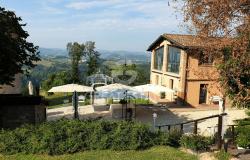
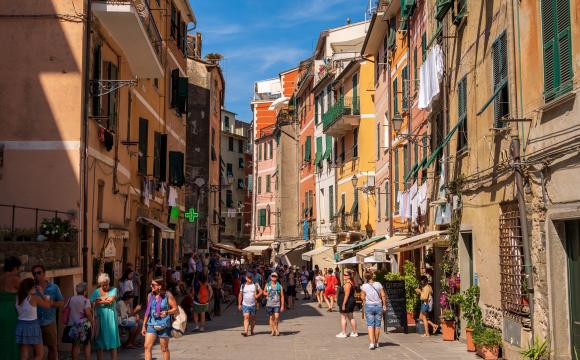
Still, it’s an undeniably beautiful place: a well-preserved medieval borgo full of history and eccentric charm, run with Singapore levels of cleanliness and efficiency and surrounded by a bucolic landscape of rolling hills and castles.
Making sense of San Marino

There’s a particular fascination here too — a curiosity about what an Italian city-state might look like today had unification never happened. Although much of what makes San Marino work is largely due to the fact that it was the only one that actually stayed independent.
No sammarinese I met had any real complaints, except about the fact their Eurovision song was called Tutta l’Italia (a national humiliation, I’m told). Beyond that, the country’s main national projects are making all of San Marino wheelchair accessible (no mean feat for anyone acquainted with the topography of Italian hill towns) and expanding a heritage railway line. That’s it.
But there’s something to be said about a country where you can stroll into parliament without so much as a bag search, where the prime minister might reply to your WhatsApp message and where the biggest national dilemma is how to make a 12th-century castle wheelchair accessible.
Even the kitsch has its charm — in a sense, the whole country is kitsch. But all the medieval pageantry, wax museums and souvenir shops serve a larger purpose: to broadcast San Marino’s independence to the world. It’s a clever strategy — a nation marketing its sovereignty as a way of preserving its sovereignty. After all, who could question the legitimacy of the world’s oldest republic, especially one so visibly committed to reminding you of it?
If you go
There’s no airport or train station in San Marino but from the Rimini train station, you can take a bus or taxi. The closest airport is Federico Fellini International Airport (RMI), served by British Airways and discount carriers including RyanAir, Wizz Air and easyJet.