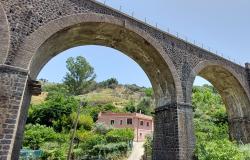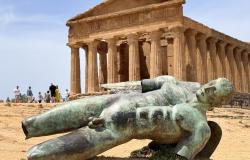


In old-town Syracuse, Sicily, at the corner of Via della Giudecca and Via del Crocefisso — “Ghetto” and “Crucifix” streets, respectively — an all but forgotten past lurks just below the surface. The low-lying Ponte Umbertino welcomes you to Ortigia — the small island that constitutes Syracuse’s historic center — and its cluster of cliched Sicilian beauty. Bored young women peddle boat tours to passing gentry; a huddle of underemployed neck tattoos smokes handrolls under an overgrown ficus; and pear-shaped fishermen stand over tangled nets, swilling bottles of early morning Birra Messina. Beyond the harbor, past the market vendors hawking white fedoras under canopies overlooking Ancient Greek ruins and Arabic-inflected modern architecture, that aptly named intersection holds the key to a culture that once was central to Ortigia. Only now, over 500 years later, is the island recovering the memory of its Giudecca.
In a square facing the crossroads stands the church of San Filippo Apostolo, or Saint Philip the Apostle. Lovely but unspectacular at first glance, it was only built in 1706, following a great earthquake from the previous decade. But as a sun-bleached sandwich sign outside the church suggests, its roots are much, much older.
The sign advertises tours of a sacred bath used for ritual purification in Judaism, hinting at the church’s past life as one of the island’s synagogues. This particular mikveh, as these baths are known, is some 18 meters (60 feet) underground. Unfortunately for me, the church is closed on the summer day when I stop by, and the few old folks strolling past can’t quite direct me toward a tour. Across the piazza, I spot a wide door to a tiny shop called Austeria; it’s open and looks promising, so I head there seeking answers and shade.
“I’m sorry, I don’t speak Italian,” drolls the shopkeeper, scribbling something at her Art Deco desk with its waterfall edges and burlwood veneer. Austeria, it turns out, is one of three locations of a Polish publishing house focused mostly on amplifying Jewish art and literature, and reviving the culture in places where it was all but eliminated. (The other two locations are in Krakow and Budapest.)
Translating my question back to English while browsing through stylish chapbooks and elegant silver menorot, I can’t help but share how pleased I am to find other Jews in this corner of the world so far from my native Los Angeles. The shopkeeper looks up, furrowing a brow buried beneath a pixie haircut. “Oh, I don’t know if you have,” she says with a mournful frown.
Jews in Sicily: roots, removal, reemergence

Jews were emigrating to Italy long before Italy was Italy. Some, like 76-year-old Barbara Aiello, the country’s first female rabbi, even theorize that Italy was christened — to use the worst possible verb — by the chosen people themselves. In fact, Italian Jewish mythology says that soldiers known as Maccabeea traveled the Mediterranean in search of mercenaries to recruit in a battle against King Antiochus IV Epiphanes. According to Rabbi Aiello, in stumbling upon the misty Calabrian coast, these Jews called it “Ee-tal-ya,” which translates somewhat erroneously to the “island of God’s dew.”
The Jews first landed on the actual island of Ortigia just over a century later, as refugees after Roman Emperor Gneo Pompeo Magno sacked Jerusalem in 57 BCE. More would arrive around a decade later, presumably as Roman slaves, followed by another large wave in 135 CE, the majority of whom fled in the aftermath of the Bar Kokhba revolt against the Romans in Jerusalem.
The Giudecca of Ortigia became Sicily’s first Jewish community, then, and would go on to thrive over the course of 1,500 years, at times making up about a third of Syracuse overall. At its peak, the Jewish population exceeded 12,000 residents — second only to Palermo.
But life wasn’t always easy for Sicilian Jews, who were required to pay additional taxes in gold merely for being Jewish. King Frederick III of Sicily, for one, oversaw several antisemitic measures during the 14th century, from requiring Jews to wear a red badge in public to destroying synagogues that advertised themselves as such.
The worst fate, however, came under the Spanish rule of Ferdinand II and Isabella I in the 15th century. When the couple weren’t sending Columbus to conquer the “new world,” they were busy trying to eradicate the 100,000-odd Jews from the island. Under the banner of the Alhambra Decree, then, Sicily’s Jews had three choices: convert, depart, or die.
Though many, tragically, suffered the third option, others, like Rabbi Aiello’s ancestors, dug in their heels, ostensibly converting to Christianity while maintaining their identity in secret. The rest, it seems, figured it would be a passing phase, given how often their lives were controlled by the fluctuating whims of whatever emperor was in power. In turn, they paid their disproportionate dues and fled.
Unfortunately for Ortigia’s Jews, the effects of the Alhambra Decree lasted much longer than expected, and it wasn’t until centuries later that a concrete impetus to revive the local culture emerged unbidden. In 1987, just around the corner from the Austeria shop along the Via Alagona, a well-to-do woman was personally renovating a long-abandoned home she’d purchased. She soon found a brick-covered doorway, and a vault of packed earth behind that. Hauling out the dirt, 156 truckloads in all, she then found a stairway, and little by little, a small, subterranean room which revealed a miraculous discovery: not merely another mikveh, but one that is believed to date back to the 6th century BCE, which would make it the oldest in all of Europe. The woman, appropriately, was named Amalia Daniele Di Bagni — Amalia “of the baths.”
The stairwell to Ortigia’s past

Today, the property housing the sacred baths is known as the Hotel Alla Giudecca, and to visit, one must check in and line up outside. My visit falls on a boiling hot Sicilian summer day, alongside a pair of elderly French tourists for whom Jewish culture might as well be extraterrestrial.
After a wait that feels like an eternity — admittedly a laughable gripe, given the temporal context of what we’re about to see — our tour guide emerges. Graying and weary (we’re her last visitors of the day), she ushers us in through an adjoining boutique, ringing up our tickets at a cash register framed with colorful Saracen dresses and ceramic beads. We move to the back of the shop and are seated in a banquet room lined with glass cases, some holding the odd Jewish artifact unearthed in the dig.
The guide’s welcome is brief, detailing the plight of those who departed this space some 531 years ago with the expectation of a quick return. She notes hastily that their priority was to seal off this sacred space, leaving it completely unknown to any outsider who might stumble upon it, sullying the waters and thereby spoiling its powers of purification.
With that seal now firmly broken, however, we’re guided down an impossibly narrow stairwell of hand-cut tuff to the three small pools, where the water is so clear as to seem invisible. Our guide welcomes us to dip a finger into the thermal waters for a sense of their curative powers, but requests that we refrain from taking pictures; as the lone Jew in the space, though, I figure a small act of civil disobedience is warranted, and smuggle a snap.
Complications in Catania and beyond
Since the discovery of the mikveh, more tangible efforts have been made in recent years to revive Jewish life on the island. In 2008, Syracuse-born Rabbi Stefano Di Mauro, who had emigrated to Miami many years prior, returned home to start a small synagogue, though it failed to fully take shape. Nearby, in Catania, a larger community of Jews have founded a synagogue in the Castle of Leucatia, a city-owned property that once belonged to a family with Jewish heritage. As recently as January 2023, Brazilian-born Rabbi Gilberto Ventura was hired to preside over services that continue to this day.
Still, as the majority of these assemblies are composed of anusim, or crypto-Jews — those who, like Rabbi Aiello, wish to reclaim their lost heritage from Jewish ancestors who converted — some conflicts have arisen between these recovered communities and Italy’s governing Jewish body, the Union of Italian Jewish Communities (UCEI). The latter questions the legitimacy of the former, and how they might coexist with those communities in the mainland whose members have never left.
As the sole arbiters of who can formally claim to be a Jewish community in Italy, the UCEI refuses to accept the synagogue of Catania, or any other such community in Sicily. In fact, per the UCEI, only 19 Jewish communities exist in all of Italy, or 28,000 Jews total, with none existing south of Naples.
Nevertheless, Rabbis Aiello, De Mauro and Ventura continue to advocate for the acknowledgement of Italy’s crypto-Jews in the hope that one day the southern communities will thrive once more. Today, as Jews prepare to bow our heads in observance of Yom Kippur, the holiest day of the year in Judaism and a chance to reflect on our misdeeds, this history of Ortigia and the larger struggle for southern visibility and belonging stands as a symbol of perseverance — and a call toward a future of unity, peace and hope.
If you go
Guided visits to the sacred bath of Syracuse (mikveh, or bagni ebraici in Italian) run daily every 30 minutes from 10am-1pm and again from 3-6pm (though in practice these times can vary). Email bagnoebraico@gmail.com or call +39 093121467 for the latest information and to book a visit. Note that, unfortunately, there are currently no accommodations for visitors with mobility issues.